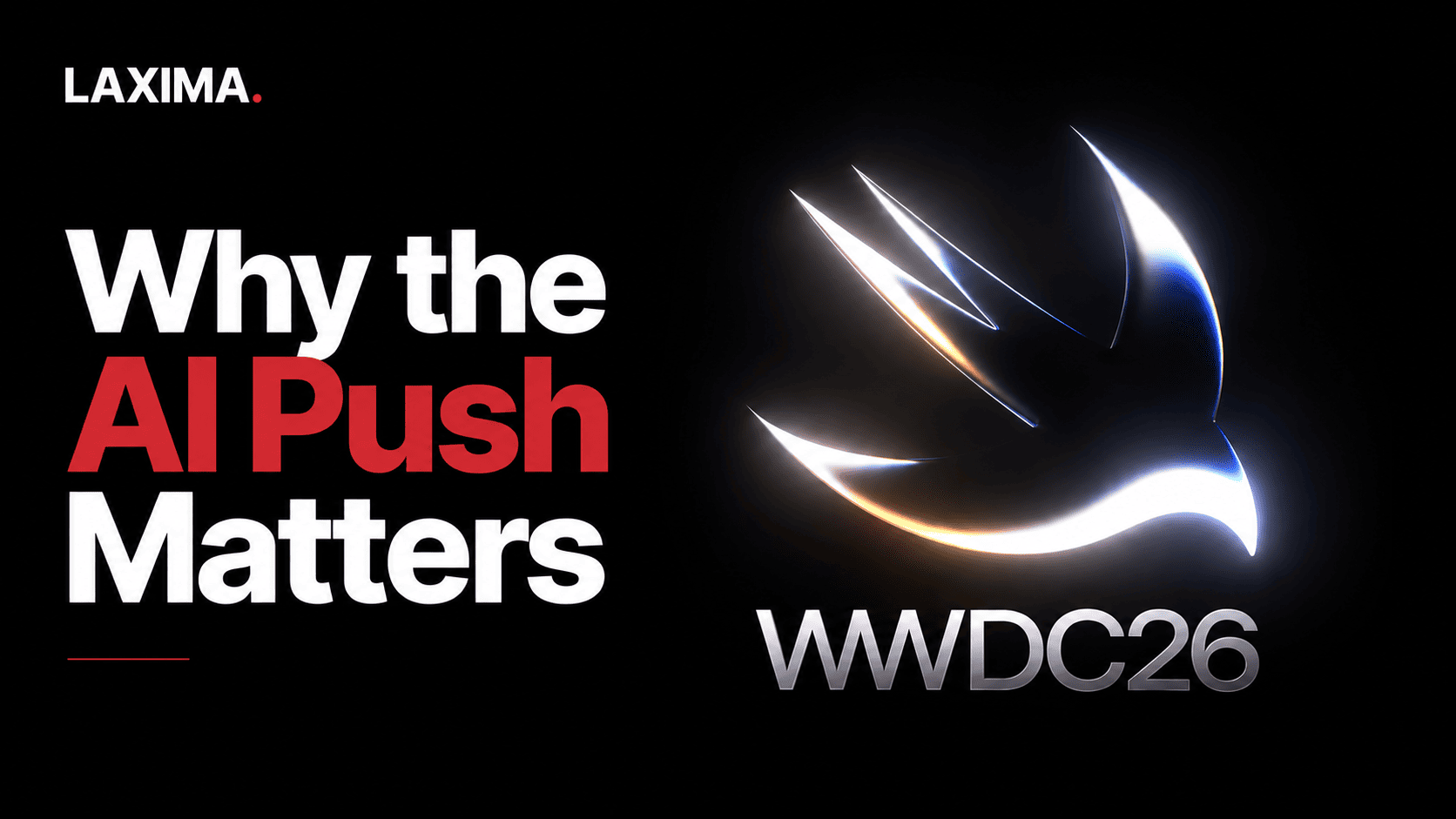
If you're looking for the fastest answer: Apple's WWDC 2026 keynote is set for Monday, June 8 at 1:00 p.m. ET / 10:00 a.m. PT, and the easiest way to watch is via Apple's YouTube channel, the Apple TV app, or Apple's Events website.
But the more interesting story is not just how to watch. It's why this year matters. WWDC 2026 is shaping up to be a major test of Apple's AI strategy: a more capable Siri, broader Apple Intelligence features, tighter integration across iOS 27 and the rest of Apple's platforms, and a clearer message about privacy-first generative AI.
At LAXIMA, our view is simple: this keynote matters less as a feature parade and more as a signal about whether Apple can turn AI from a chatbot novelty into a deeply embedded user experience. That shift is where real product value gets created.
How to watch the WWDC 2026 keynote
Apple typically makes WWDC easy to follow, and this year appears no different. Based on Apple's standard event distribution and current reporting, there are three primary ways to watch live:
Apple's YouTube channel for the most universal viewing option
The Apple TV app across supported devices
Apple's Events website for direct browser viewing
If you just want the least-friction option, YouTube is usually the safest pick. It works on nearly every device, supports reminders, and is often the easiest stream to share internally with teams.
WWDC 2026 keynote time
The keynote is expected to begin at:
1:00 p.m. Eastern Time
10:00 a.m. Pacific Time
If you care about announcements in real time, join 10 to 15 minutes early. Apple streams usually start cleanly, but major events can still create platform congestion, especially on third-party platforms.
What Apple is expected to announce at WWDC 2026
The biggest expected reveals are Apple's next operating system releases. Most reporting points to updates across the full platform stack:
iOS 27
iPadOS 27
macOS 27
watchOS 27
tvOS 27
visionOS 27
That part is standard WWDC. The less standard part is the expectation that Apple will use this event to reset the conversation around Siri and generative AI.
In practical terms, the keynote will likely revolve around three storylines:
A rebuilt Siri experience
Expanded Apple Intelligence features
Software quality, performance, and battery life improvements
That combination matters because it reflects a broader product strategy: add visible AI improvements, but package them inside the things normal users already care about, like speed, reliability, and everyday usefulness.
iOS 27: the update most people will care about
For most viewers, WWDC is really an iOS event. Everything else matters, but iOS 27 will shape the headlines.
Current expectations suggest Apple will focus less on dramatic visual reinvention and more on improving the intelligence layer of the iPhone experience. That means iOS 27 may end up being remembered not for one flashy redesign, but for whether it makes the phone feel more helpful in dozens of small ways.
Likely iOS 27 themes
Siri upgrades with more conversational responses and multi-step task handling
AI features embedded into core apps such as Messages, Photos, Safari, and productivity workflows
Refinements to the existing design language rather than a full visual reset
Bug fixes and performance work aimed at responsiveness and battery efficiency
This is a pattern we see across AI product markets: once the novelty wave passes, users care less about whether a company has "AI" and more about whether the software saves time, reduces friction, or removes annoying steps. If Apple executes well, iOS 27 could quietly become one of its most important updates in years.
Siri may be the real headline
Multiple reports point to a major Siri overhaul, potentially including a more chatbot-like interface, stronger language understanding, and better support for context-aware, multi-step interactions.
That matters because Siri has long been one of Apple's most strategically important but uneven products. It sits at the center of voice, intent, and device orchestration, yet it has often lagged behind newer AI assistants in flexibility and usefulness.
What a meaningful Siri upgrade would actually require
For Siri to feel truly new, Apple likely needs to improve more than just the wording of responses. A real upgrade would include:
Context retention across turns in a conversation
Multi-step planning, such as combining calendar, messages, maps, and reminders in one request
App-level action taking instead of merely answering questions
More natural language interaction that feels less command-based
Trust and privacy controls users can understand
For example, a stronger Siri should handle something like: "Move my 3 p.m. meeting to next week, message the attendees, and set a reminder for me 30 minutes before the new time." That's the bar now. Not clever demos, but dependable execution.
If you follow the broader AI assistant market, this is exactly where the competition is moving. Agent-like systems are becoming useful not because they talk better, but because they can reliably do work. We've covered that shift in our guide to agentic AI systems for business automation.
The Google Gemini partnership: Siri's new engine
The biggest piece of context behind WWDC 2026 is not on Apple's slide deck - it's already been announced. On January 12, 2026, Apple and Google jointly confirmed that a custom version of Gemini will power the next generation of Siri, ending months of speculation and reframing what "Apple Intelligence" actually means under the hood.
The deal terms reported across multiple outlets:
Apple is paying Google approximately $1 billion per year for a custom 1.2 trillion parameter Gemini model - roughly eight times larger than Apple's existing 150 billion parameter cloud models
The model uses a mixture-of-experts (MoE) architecture, purpose-built for tasks like summarization, planning, and natural language understanding
Apple evaluated OpenAI's ChatGPT and Anthropic's Claude before selecting Gemini
First Gemini-powered Siri features are expected to ship with iOS 26.4 in spring 2026, with the broader chatbot-style Siri redesign anticipated for iOS 27 at WWDC and a general release in September 2026
Why this matters for the keynote
WWDC 2026 is the first developer-facing event where Apple has to explain this architecture publicly. Up to this point, the partnership has been a press-release headline. On stage, Apple needs to answer questions developers actually care about: which Siri interactions route to Gemini versus on-device models, what APIs apps need to participate, and how App Intents fit into the new orchestration layer.
App Intents are likely the gating dependency - apps that haven't implemented them by WWDC may miss the first wave of Gemini Siri integration, and the older SiriKit framework is expected to receive a formal deprecation notice. That detail will not make the keynote highlight reel, but it will determine whether the new Siri actually works inside the apps people use.
The privacy architecture is the whole story
The obvious tension: Apple has spent years positioning itself against cloud-dependent AI, and now it's licensing the brain of its assistant from Google. The reconciliation lives in the infrastructure.
Apple plans to run the Gemini-based model on its own Private Cloud Compute servers - Google supplies the model weights, while Apple keeps inference behind its own walls. Apple states that no user data is shared with Google and that data is not stored after processing; the Gemini model weights run within Apple's infrastructure, not on Google's servers.
In practice, this means three things developers and users should understand:
The model is Google's; the runtime is Apple's
There is no Google branding in the user-facing interface - most users will never know Gemini is involved
Apple's existing ChatGPT integration remains separate and is not being replaced by this deal
The strategic read
This is the part the keynote will not say plainly: Apple is effectively conceding that it has not yet built a competitive frontier model in-house. The arrangement is reportedly temporary - Apple is developing its own ~1 trillion parameter model that could launch by late 2026 - but the company has lost a meaningful number of senior AI researchers to Meta, OpenAI, and Anthropic, which makes the timeline credible but not guaranteed.
Our LAXIMA view: licensing Gemini is the right move for Apple right now, precisely because the durable advantage in this category is integration, not model ownership. If Apple uses the next 12-18 months to ship Gemini-powered Siri at scale while quietly closing the model gap in-house, the partnership will look strategic in hindsight. If Apple stays dependent on Google past iOS 28, the optics get harder.
The keynote signal to watch: how confidently Apple positions Gemini on stage. Heavy emphasis on "Apple Foundation Models" with Gemini mentioned almost in passing → Apple is treating this as transitional. Direct co-marketing or visible Gemini branding → the dependency is deeper than the press release suggested.
Apple Intelligence in 2026: bigger than one keynote
One competitor source highlighted a newly noticed Apple subdomain tied to generative AI. Whether that specific domain becomes important or not, the larger point is credible: Apple appears to be carving out a more explicit generative AI identity.
That would be a notable shift. Apple has often preferred abstract or brand-safe language over directly chasing market buzzwords. A more open "Gen AI" framing suggests Apple may be preparing to speak more plainly about its place in the generative AI race.
Where Apple Intelligence could expand
Based on the current reporting, likely areas include:
Photos for image editing, search, organization, or creation assistance
Messages for summarization, drafting, or smart reply features
Safari for page summarization, answer generation, or contextual assistance
Productivity apps for rewriting, organization, and task generation
Developer-facing tooling if Apple exposes more AI capabilities to app builders
The developer angle is especially important and often undercovered in consumer previews. WWDC is, after all, a developer conference. If Apple wants AI adoption to spread across its ecosystem, it needs to provide frameworks, APIs, safety controls, and interface patterns developers can actually ship with.
This is where ideas like Generative UI become relevant. The next phase of AI is not just model output in a chat box. It is interfaces that adapt to user intent, app context, and task structure. Apple is well positioned to push this if it opens the right tooling.
Why Apple's privacy-first AI strategy could resonate
Apple's likely differentiator is not that it has the biggest model or the most aggressive release cadence. It's that the company can package AI around three ideas mainstream users already understand:
Privacy
On-device performance
Tight ecosystem integration
That positioning matters. Many users still feel a trust gap with generative AI, especially around personal data, cloud processing, and unexplained outputs. Apple's opportunity is to make AI feel less like a separate product and more like a secure system capability.
What privacy-first AI looks like in practice
A strong Apple AI story would likely include:
More processing done on device when feasible
Cloud-routed queries (including Gemini-powered Siri requests) handled inside Apple's Private Cloud Compute, not third-party infrastructure
Clear separation between local tasks and cloud-assisted tasks
Permission models users can actually understand
Scoped access to personal context rather than broad, invisible ingestion
Fewer "black box" interactions in sensitive workflows
In other words, Apple does not need to win the AI race by being the loudest. It can win by making AI feel safer, calmer, and more embedded in everyday usage.
That same trust question is why model selection matters more than ever. If you're comparing ecosystems beyond Apple, our LLM Picker is a practical way to think through tradeoffs by use case rather than hype.
Will WWDC 2026 be about features or about catching up?
That is the core strategic question.
Some observers will frame WWDC 2026 as Apple finally catching up in generative AI. There is some truth to that. Apple has not defined the public AI conversation the way OpenAI, Google, and Anthropic have.
But catching up is not the same thing as losing.
In platform markets, the winner is often not the company that launches first. It is the company that integrates best, scales trust fastest, and turns new capability into default behavior. Apple has done that before in categories it did not invent.
Our view at LAXIMA is that WWDC 2026 should be judged on three criteria:
Usefulness: Do the announced features solve real user problems?
Integration: Are the capabilities embedded across the OS, apps, and developer stack?
Reliability: Do they feel production-ready, not just demo-ready?
If Apple delivers all three, the "catch-up" narrative will fade quickly.
The underreported angle: software quality may matter more than flashy AI
One of the more credible expectations is that Apple will also emphasize bug fixes, performance improvements, and battery life.
This is easy to underestimate, but it may be one of the smartest parts of the strategy.
AI features increase system complexity. They add inference layers, background processing, memory pressure, and new UX edge cases. If Apple tries to pile advanced intelligence onto unstable software, users will not care how impressive the keynote looked.
Why stability is now part of the AI product story
Users experience AI quality indirectly through things like:
App responsiveness
Battery drain
Notification accuracy
Latency in assistant interactions
Whether suggestions are helpful or annoying
That means software quality is no longer separate from the AI story. It is part of the AI story.
This is a theme we see across automation projects too: the glamorous layer gets attention, but operational reliability determines adoption. For teams thinking about rollout, our piece on how to make employees use AI effectively covers why enablement and guardrails matter as much as capability.
What developers should watch for beyond the keynote headlines
Most event coverage focuses on consumer features. Developers should watch for a different set of signals.
Key questions for developers
Will Apple introduce new APIs for generative features?
Will there be model access for app builders, or only system-level capabilities?
How much AI runs locally versus through Apple-managed cloud infrastructure?
Will developers get evaluation tools, cost controls, or safety layers?
How deeply will Siri or Apple Intelligence connect to third-party apps?
Those details matter more than keynote language. If Apple provides robust tooling, WWDC 2026 could accelerate AI-native app behavior across the ecosystem within 6 to 12 months. If it stays mostly at the first-party feature layer, the impact will be more limited.
The broader market has already shown that AI platforms win when they pair strong models with usable control planes, governance, and implementation paths. We've seen that clearly in enterprise systems such as Microsoft Agent 365's approach to agent governance.
A practical WWDC 2026 watch checklist
If you want to get more value from the keynote than passive watching, use this checklist:
Before the event: Set a reminder, choose your stream, and note the top three things you care about
During the event: Separate confirmed announcements from vague future promises
After the event: Check developer session details, not just recap headlines
If you use Apple devices heavily: Watch for compatibility, rollout timing, and regional availability
If you build products: Look for APIs, app integrations, privacy architecture, and developer constraints
This is especially important in AI-heavy announcements, where the difference between "shown on stage" and "available soon" can be substantial.
How WWDC 2026 fits into the broader AI race
Apple is entering a market where expectations are now shaped by rapidly improving model ecosystems, multimodal interfaces, and increasingly agentic workflows. The bar is much higher than it was even a year ago.
Users now expect AI systems to:
Understand context
Work across modalities
Take actions, not just generate text
Respond quickly
Respect privacy and permissions
That puts pressure on Apple to do more than attach AI labels to existing features. It needs to make AI feel native to the operating system.
And as the AI market matures, we think the durable advantage shifts from standalone novelty to integration. That is why platform players still matter enormously, and why WWDC 2026 could be more consequential than many model launch events.
You can see this same pattern in adjacent AI categories, including media generation, where the center of value is moving from isolated model demos to workflow integration and production usability. Our analysis of AI video generation in 2026 shows the same trend clearly.
If you just want the logistics, WWDC 2026 will be easy to watch: YouTube, Apple TV, or Apple's Events page at 1:00 p.m. ET on June 8.
If you care about what really matters, watch for something bigger: whether Apple can translate generative AI into a stable, useful, privacy-conscious operating system experience.
That is the real test.
Not whether Siri sounds more modern for five minutes on stage, but whether Apple shows a credible path to making AI consistently helpful across the products millions of people already use every day.
FAQ
When is Apple’s WWDC 2026 keynote?
WWDC 2026 is expected to begin on Monday, June 8 at 1:00 p.m. ET / 10:00 a.m. PT.
Where can I watch the WWDC 2026 keynote live?
You can watch through Apple’s YouTube channel, the Apple TV app, or Apple’s official Events website.
What is Apple expected to announce at WWDC 2026?
The biggest expected announcements are iOS 27, iPadOS 27, macOS 27, watchOS 27, tvOS 27, visionOS 27, and major Siri and Apple Intelligence updates.
Will Apple focus heavily on AI at WWDC 2026?
Most signs point to yes. Siri upgrades, broader Apple Intelligence features, and stronger generative AI positioning are expected to be central themes.
Why does WWDC 2026 matter beyond Apple fans?
Because Apple’s approach can influence how mainstream users experience AI: not as a standalone chatbot, but as a built-in system layer across devices, apps, and workflows.