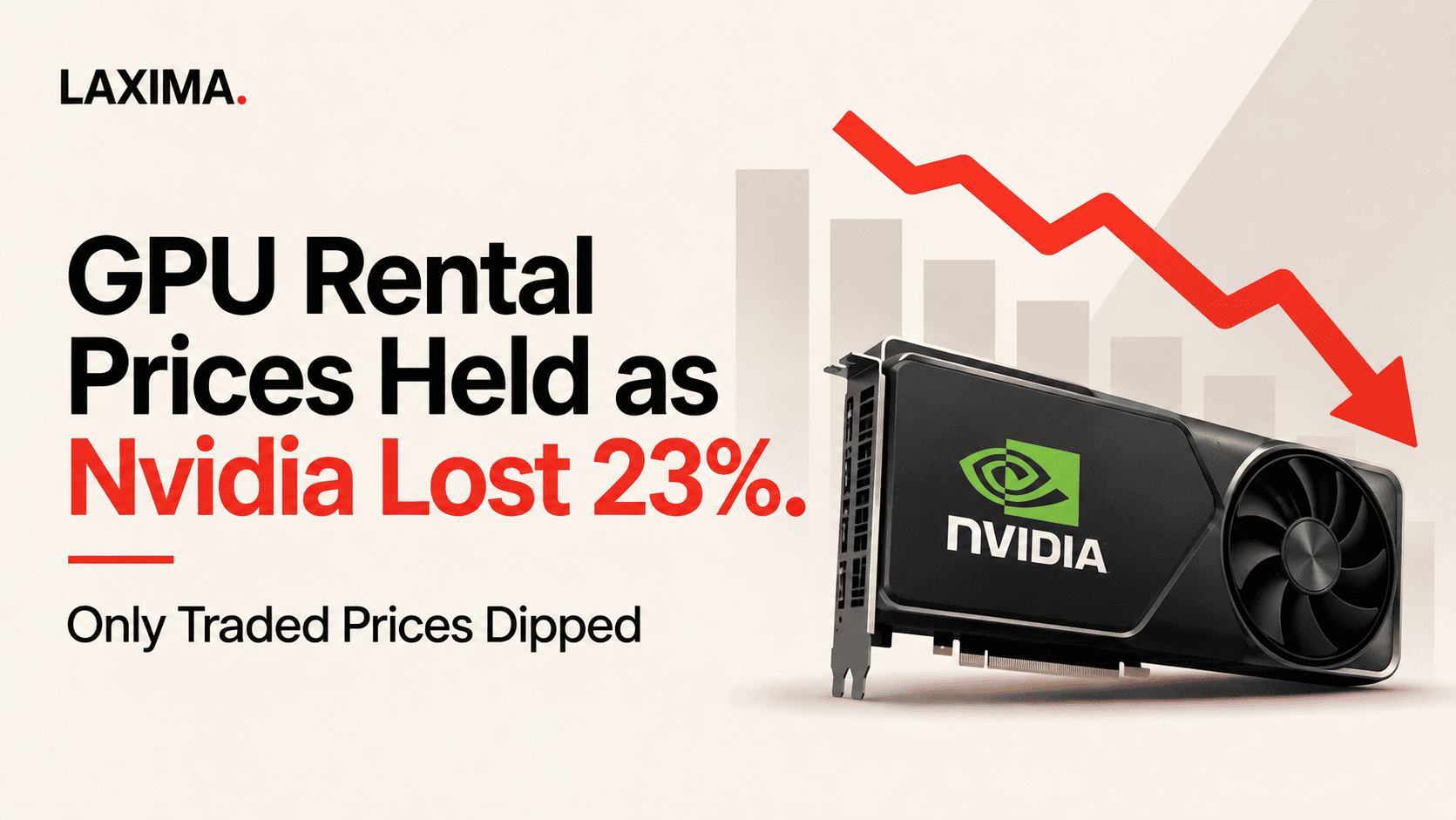
None of the on-demand GPU rental prices we checked were cut in the week Nvidia lost 23% (16 to 20 November 2026). Lambda and RunPod had already published H100 rises of 15% and 10%, and CoreWeave held. Traded prices did dip: Ornn's index of on-demand H100 rentals fell 12% that week. If you need GPUs in December, don't wait for a list cut. Shop below list for H100 and take list for Blackwell.
What we read: public on-demand list prices at five GPU clouds and one API vendor on 22 and 23 November 2026, set against Internet Archive captures from 11 October to 6 November, plus Ornn's public index of traded prices. Percentages, monthly costs and breakevens below are our own arithmetic from the linked prices. We saw no reserved or negotiated rates.
The pages did not follow the shares back up either. On Monday 23 November Nvidia said it was reinstating Jensen Huang as chief executive, and its shares closed 31% higher on Nasdaq's quote data. The Lambda, RunPod, CoreWeave, Crusoe and Nebius pages we re-read that evening were unchanged.
Lambda and RunPod published their increases before Nvidia reported
Prices are per GPU-hour. Each links to the page or Internet Archive capture we read it from, and Crusoe's page prints both columns.
Provider | Instance | Before | After | Dated |
|---|---|---|---|---|
Lambda | 8x H100 | $4.59 (+15.0%) | effective 16 Nov 2026 | |
Lambda | 8x B200 | $7.69 (+14.9%) | effective 16 Nov 2026 | |
Lambda | 8x A100 80GB | $3.19 (+14.3%) | effective 16 Nov 2026 | |
RunPod Secure Cloud | H100 SXM | $4.39 (+10.0%) | page updated 12 Nov 2026 | |
RunPod Secure Cloud | A100 SXM | $2.19 (+22.3%) | page updated 12 Nov 2026 | |
CoreWeave | HGX H100 | $6.16 (none) | 3 Nov vs 23 Nov 2026 | |
CoreWeave | HGX B200 | $8.60 (none) | 3 Nov vs 23 Nov 2026 | |
Crusoe | H100 | $4.50 (+15.4%) | published for 1 Dec 2026 | |
Crusoe | H200 | $5.40 (+25.9%) | published for 1 Dec 2026 |
Lambda's page carried its notice in a 5 November capture: "These prices take effect November 16, 2026, at 00:00 UTC." RunPod's page is dated 12 November, five days before Nvidia's results on the 17th. RunPod raised 9 of its 21 Secure Cloud prices and cut none.
So the sell-off week caused neither rise, and neither provider gave a reason. Sub Pulse, which read six pricing pages on 9 November, wrote: "We do not know why prices are rising, and the pricing pages do not say."
The broadest independent check agrees. AIForge Works compared nine providers' catalogs for 8 to 15 November: "Across 13,933 GPU price listings we could match week over week, only eight moved more than 1%, all increases at Lambda."
Lambda also has no share price to fall. It is private, and was reported to be seeking up to $4B of private financing ahead of a possible 2027 IPO. CoreWeave, the listed neocloud in the table, lost 26% that week and changed no price.
Traded prices fell that week, and the gap to list depends on the GPU
Ornn publishes a daily index of what on-demand GPU rentals trade at. AIForge describes it as tracking "the traded price of compute rather than quoted or listed prices", on-demand only, with reserved and forward contracts out of scope. We pulled five series from its keyless API on 23 November. We don't know which venues it samples.
GPU | Traded index, 13 Nov to 20 Nov | Cheapest list price we read |
|---|---|---|
A100 SXM4 | $1.04 to $1.00 (-3.8%) | $2.19 at RunPod (80 GB), 119% above the index |
H100 SXM | $3.29 to $2.90 (-11.9%) | $3.90 at Crusoe, 34% above the index ($4.50 from 1 Dec) |
H200 | $6.73 to $6.14 (-8.8%) | $4.29 at Crusoe, 30% under the index ($5.40 from 1 Dec) |
B200 | $9.72 to $9.10 (-6.4%) | $7.69 at Lambda, 15% under the index |
B300 | $10.52 to $11.59 (+10.2%) | $8.96 at Crusoe, 23% under the index ($9.90 from 1 Dec) |
Four of the five fell in the sell-off week, so "no price fell" is true of price pages only. Read the fall with care. The H100 series is noisy: it went from $3.02 to $3.53 in two days at the start of November, and at $2.90 it sits 2% above its reading of $2.84 on 6 October, the day of the Nasdaq's record close. B200 and H200 are still about 20% above theirs. B300, the newest card here, rose during the sell-off.
The split by generation is the useful part. Over the three months of history the public API returns, the A100 and H100 indexes are down about 6% while B200 and H200 are up about 40%. For A100 and H100 the list price is well above what rentals trade at, and Lambda and RunPod raised those lists anyway. For H200, B200 and B300 the cheapest list price is under the traded index, so an instance at list, if you can get one, is the deal.
This sets a catalog price against an index with no region matching, so treat the gaps as rough.
H100 list prices span more than 2x, and B200 has no cheap tier
On-demand H100 per GPU-hour, read on 22 November 2026. Lambda's 8-GPU node is now 33% under AWS. At $2.99 a year earlier it was 57% under.
Provider and instance | Per GPU-hour, and discount to AWS |
|---|---|
Vast.ai marketplace, H100 SXM | $2.03 (median of 10 asks, one snapshot) |
RunPod, single H100 PCIe | $2.89, 58% under |
Lambda, single H100 PCIe | $3.79, 45% under |
Crusoe, H100 | $3.90, 43% under ($4.50 and 35% from 1 Dec) |
RunPod, single H100 SXM | $4.39, 36% under |
Nebius, H100 | $4.50, 35% under |
Lambda, 8-GPU H100 node | $4.59, 33% under |
CoreWeave, 8-GPU H100 node | $6.16, 11% under |
AWS p5.48xlarge, 8 GPUs | $6.88, the baseline |
The top reaction on the Hacker News thread about the SEC report was: "So where my cheap Blackwell GPUs at?" On these pages, nowhere.
Provider and instance | B200 per GPU-hour |
|---|---|
CoreWeave spot, 8-GPU node | $4.26 (preemptible) |
Lambda, 8-GPU B200 node | |
Lambda, single B200 | |
RunPod, single B200 | |
Vast.ai marketplace | $8.16 (median of 22 asks) |
Nebius, B200 | |
Crusoe, B200 | $8.50 from 1 Dec (contact sales today) |
CoreWeave, 8-GPU B200 node |
H100 on-demand lists run from $2.89 to $6.88, and a marketplace host or CoreWeave spot ($2.46) goes lower. B200 lists sit within 12% of each other, the marketplace median is above Lambda's list, and the traded index is above all of them. The only cheap Blackwell we read is preemptible.
Three caveats on the tables. Node rows are per-GPU shares of an eight-GPU machine, so you cannot rent one GPU at that price. The Vast.ai rows are asks from its offers API, filtered by GPU, in one snapshot on 22 November, and marketplace prices leave out storage and transfer. AWS is read from Vantage's mirror of its price list, and it is the cheapest hyperscaler by a distance: AIForge's catalog has OCI at $10.00, GCP at $11.06 and Azure at $12.29 for the same card.
At 730 hours a month, one H100 costs $2,110 on a RunPod PCIe card, $3,351 on Lambda's node and $5,022 at AWS.
Don't wait for a list cut: shop below list for H100, take list for Blackwell
H100 and A100: treat list as a ceiling. The traded index is $2.90 against lists of $3.90 to $4.59. A RunPod H100 PCIe at $2.89 is $1.50 an hour under its SXM price, and CoreWeave spot is $2.46 if you can lose the instance.
H200, B200 and B300: take list if you can get it. Lists are under the traded index, and CoreWeave spot at $4.26 is the only B200 discount we read. We launched no instance, so we can't tell you the capacity is there. Lambda's page calls its instances "self-serve, first-come access".
December: Crusoe's rises are already published. On 1 December its H100 goes from $3.90 to $4.50 and its H200 from $4.29 to $5.40.
Reserved: get a quote. We have no reserved prices. Lambda and Crusoe both say on their pricing pages that reserved capacity is their lowest rate, and both price it through sales. The one committed product Lambda prices in public is 1-Click Clusters, 16 or more GPUs for two weeks to a year: H100 at $6.16 per GPU-hour for 16 GPUs, $5.85 for 64 and $5.54 for 256. That is a cluster, so it does not compare with one node.
If you buy tokens, keep a second model in configuration. One team that moved from its own GPUs to hosted APIs says the switch "took minutes, with no deployment". Our LLM picker compares prices side by side for choosing that second model.
If you sell flat plans, cap spend before the call. A founder on $19 plans reran the numbers "with model costs 30% higher and about 1 in 6 accounts went negative".
If your GPUs are on a reserved contract or committed hyperscaler spend, none of this covers you. We read on-demand prices only.
Why did GPU rental list prices rise?
Scarcity fits Blackwell. For H100 we can't tell. No provider gave a reason, so this section is inference.
For Blackwell and H200, scarcity fits the numbers: traded prices above list, and indexes up about 40% in three months. Lambda's backlog was reported growing from about $15B in June to roughly $50B in September. The link from that to its prices is ours.
For H100 and A100 it fits less well. Lists rose 10 to 22% while the traded indexes went sideways, which looks like a pricing decision on the tier where workloads are already running. We can't tell that apart from scarcity without availability data, and we collected little. Vast.ai showed 10 rentable H100 SXM offers covering 19 GPUs in our snapshot. SemiAnalysis wrote back on 2 April 2026: "On-Demand GPU rental capacity is sold out across all GPU types".
Share prices explain neither. Lambda's H100 went from $2.99 to $3.99 by May while the PHLX Semiconductor index rose 66%, then to $4.59 with the index 23% under its 6 October close. It rose in a rally and in a rout. The top reply to "Cheaper GPUs are coming next year!" on r/LocalLLaMA put it shorter: "The relationship between stock price and product price doesn't work how you think it does."
Nvidia's own account points the same way. On the 17 November call Colette Kress, interim CEO at the time, said "GPU rental prices are rising across generations" and that Hopper GPUs "have recontracted at up to twice their original price". She gave no data. What we could check shows about +50% in a year for H100: Lambda's list is up 53.5% on the November 2025 capture, and Silicon Data's neocloud index, as summarised by Rillor, went from $2.00 to $3.06.
Kress also said Nvidia "moved to a new pricing as we moved into the new year", and that for allocation a customer's capital "needs to be set up, ready to go". Neither was quantified. If both hold, newly built capacity will not cost neoclouds less next year.
Dearer money is a reason new supply will be slow. CoreWeave's third quarter showed $846M of net interest expense on $3,661M of revenue, or 23%. With some of its bonds yielding above 16%, its CFO told investors on 10 November: "At current yields, we do not intend to issue additional parent-level unsecured debt through 2027." CoreWeave's is also the one price list that did not move, so financing cost does not explain November's rises.
Nvidia and Anthropic print the same financing condition
Nvidia's Q3 CFO commentary lists $32B of agreements under which it commits to rent capacity back from neoclouds, and adds: "Our commitments take effect only if the neoclouds secure financing to purchase the data center infrastructure products". The Q2 commentary had the same line at $36B with no such sentence.
Asked on the call whether that was a change, Kress answered: "Is it new? No. Did we change anything? No." Nvidia does not say why the line fell by $4B. Its Q2 10-Q describes one benign route: capacity the clouds "can unilaterally stop providing to us and sell to third-party customers at more advantageous rates".
Anthropic's final prospectus states "aggregate committed spend of approximately $900.9 billion, substantially all of which is related to compute and infrastructure". About $186.2B of that (20.7%) sits in arrangements with termination rights or conditions that must be met first, the counterparty's financing among them. That is our paraphrase: we read those passages through an extraction tool. CNBC reports that Nscale, one of the neoclouds named in it, has no binding financing commitments yet for its Anthropic contracts.
So the supplier's backstop starts only once the neocloud is financed, and the customer's capacity can lapse if it is not. Nvidia does not name the neoclouds behind the $32B, so these may not be the same agreements.
For a renter the consequence is narrow. If a neocloud's financing fails before the hardware is bought, that capacity never reaches the on-demand pool. As of 22 November we found no report of a neocloud failing to deliver.
Claude API list prices did not change around the IPO
Every Claude model on both the 6 November capture and the live pricing page on 22 November has the same price. Opus 5.5 is $4 / $20 per million input / output tokens, Sonnet 5.5 $2 / $10, and Haiku 5.5 $0.10 / $0.50 for prompts up to 100,000 tokens. Our breakdown of the Claude rate card covers the step above that. The new rows are cheaper than what they replace: Fable 5.2 at $8 / $40 is 20% under Fable 5.1.
Anthropic's 26 October S-1 says it has "changed, and may in the future change, usage limits, rate limits, or model and product capabilities". In the week it listed, several Claude Code subscribers reported burning through limits faster, with no token logs. A measurement repo blames cache expiry instead: "Claude Code usage is driven by cache misses, not by how much you type." Its author marks most rows preliminary.
We did not compare Anthropic's API rate-limit tables before and after the listing, so we can't say whether limits moved. If you run on the API, log every 429 with its error body.
A rented H100 needs 2,300 to 6,100 output tokens a second to match Crusoe's per-token price
Crusoe's page prices serverless GPT-OSS 120B at $0.05 per million input tokens and $0.25 per million output. The model card says the model runs on a single 80 GB GPU. The table shows the output tokens per second, nonstop, at which an H100 costs the same as paying per token.
H100 you rent | Per hour | Output only | With input billed at 2:1 |
|---|---|---|---|
RunPod H100 PCIe, you run the server | 3.2k tokens/s | 2.3k tokens/s | |
Crusoe H100 instance, you run the server | 4.3k tokens/s | 3.1k tokens/s | |
Crusoe dedicated endpoint, Crusoe runs it | 6.1k tokens/s | 4.4k tokens/s |
The arithmetic is the hourly rent divided by the price per million output tokens, then by 3,600. That price is $0.25, or $0.35 once two input tokens are billed for each output token. A GPU that is busy half the time needs twice the figure while it is busy, which is our own rule of thumb.
We measured no throughput and found no figure for GPT-OSS 120B on one H100. The one measured number we can cite is for a far smaller model. In a benchmark by an employee of a GPU host, Qwen2.5-7B on vLLM on an H100 PCIe reached 4,515 tokens a second with 64 requests in flight, at $0.22 per million output tokens. With one request at a time it cost $9.47.
Unless your traffic keeps a GPU saturated, buy tokens. If the workload fits on a workstation, our guide to which coding work local models handle covers that route.
How we measured, and what would change our view
We pulled share prices and price pages on 22 November 2026 with curl and standard-library Python, then re-read five pricing pages and pulled Ornn's index on 23 November. Closes come from Yahoo Finance's unofficial chart API. Nvidia's were checked against Nasdaq's historical data and Investing.com's closing report. Wayback captures and sec.gov documents came through two scraping services after direct requests were refused. We did not rent a GPU, check availability, measure tokens per second or measure Claude limits.
"Worst week since March 2020" is true of the Nasdaq by a hair. From Yahoo's daily closes the Composite fell 10.0195%, its 10th-worst week of 2,911 since 1971, against 10.0167% in the first week of April 2025. For the S&P 500 the label is false: its April 2025 week was worse. For chips it undersells the week. The PHLX Semiconductor index fell 17.13%, its worst week since September 2001.
One trap if you rebuild this: range=max&interval=1wk returns HTTP 200 and silently hands back monthly or quarterly bars. Pull period1=0&interval=1d and build the weeks yourself.
Nvidia was already down more than 6% on Friday 20 November when Reuters reported, citing two people briefed, that SEC enforcement staff are scrutinizing potential accounting issues at the company. The shares closed 14% lower. As of 22 November neither the SEC nor Nvidia had confirmed it.
Three things would change our view: a list-price cut at any provider above, the H100 gap between list and traded closing through list cuts, or a reported case of reserved capacity not being delivered. In seven Hacker News threads and 19 Reddit threads, nobody reported an invoice that changed because of that week.
The date to watch is 4 December. Nvidia's 10-Q is due by then, 40 days after the 25 October quarter end, and may explain the $4B. Re-read the price pages the same day.
Cover image: screenshot of Lambda's pricing page, 23 November 2026.
Have GPU rental prices fallen since the November 2026 AI stock crash?
List prices have not. As of 23 November 2026 none of the on-demand GPU list prices we checked had fallen: Lambda and RunPod raised H100 by 15% and 10% before Nvidia reported, CoreWeave held, and Crusoe has published a 15% rise for 1 December. Traded prices dipped: Ornn's on-demand H100 index fell 12% in the week of 16 to 20 November.
Did Anthropic raise Claude API prices after its IPO?
No. Anthropic began trading on 19 November 2026, and every Claude model on its API pricing page on both 6 and 22 November had the same price. Fable 5.2, added in November, costs 20% less than Fable 5.1. Anthropic's S-1 says it has changed usage and rate limits before and may again.
Does Nvidia guarantee the capacity that neoclouds sell?
Not unconditionally. Nvidia's Q3 fiscal 2027 CFO commentary says its $32B of commitments to rent capacity back from neoclouds, the GPU-specialist clouds, take effect only if the neocloud secures financing for the hardware. For a renter, new neocloud capacity depends on that financing. As of 22 November 2026 we found no report of a neocloud failing to deliver.
Is the SEC investigating Nvidia's accounting?
It has been reported but not confirmed. Reuters, citing two people briefed, reported on 20 November 2026 that SEC enforcement staff are scrutinizing potential accounting issues at Nvidia, and said the Wall Street Journal had reported the probe's existence three days earlier. As of 22 November 2026 neither the SEC nor Nvidia had confirmed it.
Was 16-20 November 2026 really the worst week for AI stocks since March 2020?
For the Nasdaq, yes. In the week of 16 to 20 November 2026 the Nasdaq Composite fell 10.02% and the Nasdaq-100 10.43%, each its worst week since March 2020. The S&P 500's 8.61% fall was smaller than its April 2025 week. Chip stocks fell further than the Nasdaq: the PHLX Semiconductor index lost 17.13% and Nvidia 22.9%.
Is it cheaper to rent an H100 or pay per token?
Pay per token unless your traffic keeps the GPU busy around the clock. At 22 November 2026 list prices, an H100 rented for $2.89 to $5.50 an hour matches Crusoe's serverless GPT-OSS 120B price of $0.25 per million output tokens only at about 3,200 to 6,100 output tokens a second, nonstop. We measured no throughput.