MAI Code 2 pricing comes with an end date: Microsoft's "40% of the cost" of GPT-6.1 Sol uses a $0.50/$2.50 per 1M-token Copilot promo that doubles to $1.00/$5.00 on 17 May 2027. Recomputed at that list price, Microsoft's own cost-per-task table puts MAI Code 2 at about 81% of Sol per task, not 40%.
At list price MAI Code 2 is level with Sol on DeepSWE 1.1 and a mid-priced model overall: cheaper per task than GPT-6.1 Sol, likely far cheaper than Claude Sonnet 5.5 or Opus 5.5 by our estimate, but its own model card scores it 26.3% on Terminal-Bench 4. Use it in Copilot for scoped, test-backed tickets and big single-pass prompts, keep a frontier model for long autonomous runs, and budget at list price.
MAI Code 2 is probably already switched on in your Copilot Business or Enterprise org, with overage uncapped, and the admin section below says what to change. We did not run either model, because that needs a Copilot seat: the numbers below are Microsoft's, recomputed by us, plus about ten users' hands-on reports.
MAI Code 2 pricing at list: 81% of Sol per task, and level with Sol on DeepSWE
Microsoft says that, averaged over DeepSWE 1.1, Terminal-Bench 2.1, SWE Atlas and FrontierCode v1.1, "MAI Code 2 gives you 98% of the performance of GPT 6.1 Sol at 40% of the cost", and 96% of Claude Opus 5.5's performance "at just 5% of the cost". The averages reproduce from the tables under its charts, but a footnote sets the condition: "MAI-Code-2 cost is shown at its 50% promotional price." The announcement gives neither the list price nor the end date. GitHub's pricing reference does: every MAI rate doubles on 17 May 2027, 181 days after launch, Flash included ($0.05/$0.25 to $0.10/$0.50 per 1M input/output tokens).
Pass rates and promo costs below come from Microsoft's announcement. We doubled every MAI cost to list price; the list and per-solved-task columns are our own calculation.
Benchmark | Pass rate % (MAI / Sol) | MAI $/task, promo | MAI $/task, list | Sol $/task | MAI list as % of Sol | $/solved task, MAI list / Sol |
|---|---|---|---|---|---|---|
DeepSWE 1.1 | 73.2 / 74.6 | $0.618 | $1.236 | $1.212 | 102 | $1.69 / $1.62 |
Terminal-Bench 2.1 | 84.6 / 85.0 | $0.081 | $0.162 | $0.265 | 61 | $0.19 / $0.31 |
SWE Atlas | 43.1 / 47.4 | $0.228 | $0.456 | $0.605 | 75 | $1.06 / $1.28 |
FrontierCode v1.1 | 52.0 / 49.4 | $0.310 | $0.620 | $0.960 | 65 | $1.19 / $1.94 |
Average | 63.2 / 64.1 | $0.309 | $0.618 | $0.761 | 81 | $0.98 / $1.19 |
Cost per solved task is cost per attempt divided by pass rate. That assumes tests catch every failure and that retries are independent.
eesel's pricing analysis and an r/accelerate commenter ("98% for 80% of the cost without the promotion") reached the same 81% independently. On DeepSWE 1.1, the first benchmark Microsoft lists, MAI ties on cost and loses on accuracy: at list it costs $1.236 per task against Sol's $1.212 and passes fewer tasks, so Sol is cheaper per solved task there.
Averaged, by our own calculation from the table above, MAI still wins per solved task at list, $0.98 to $1.19, about 18% cheaper (59% cheaper at the promo price). After May 2027 the honest pitch is a bit cheaper than Sol and a bit worse, not 40% of the cost.
That Sol is also no longer current. OpenAI replaced it the same day with GPT-6.2 Sol, which "keeps GPT‑6.1 Sol's API token prices" and costs the same $2/$10 in Copilot. Nobody has published 6.2 Sol's cost on Microsoft's tasks. Its one public cost figure is on the Terminal-Bench 4.1 board, where its full run cost $349 against 6.1 Sol's $634, for a slightly higher score, 61.5% vs 60.9%. That is a different benchmark and harness, but if the efficiency carries over, 81% understates what MAI Code 2 costs relative to the Sol that Copilot serves today.
The table implies MAI uses about 1.6x Sol's tokens
At list, MAI's per-token rates are exactly half of Sol's Copilot rates ($1/$5 vs $2/$10, cached $0.05 vs $0.10). A per-task cost at 81% of Sol, at half Sol's per-token rate, means about 1.6x the tokens. Per benchmark the multiplier is about 2.0x on DeepSWE, 1.5x on SWE Atlas, 1.3x on FrontierCode and 1.2x on Terminal-Bench 2.1. The gap is widest on DeepSWE, which is the most expensive benchmark per task for every model.
Microsoft publishes no token counts, so the multiplier is our inference. Sol's API list price and its Copilot rate are the same $2/$10, so the price basis barely matters. The unknowns are the cache mix and the input/output split. If Sol's costs include its $2.50 cache-write fee, which MAI doesn't charge, the real multiplier is higher. eesel's summary: "Half the sticker, most of the bill."
One real-world run fits the same picture. In a same-prompt audit, MAI Code 2 used 19.09 AI credits to Sonnet 5.5's 136.36. At promo, MAI's per-token rate is a quarter of Sonnet's, so by our own arithmetic MAI used about half of Sonnet's tokens. That doesn't contradict the 1.6x against Sol, because Sonnet is the hungrier model: on the Terminal-Bench 4.1 board, in their own harnesses, Sonnet 5.5 used 19.4B tokens to GPT-6.1 Sol's 1.5B. It is still one run on one repo, and the test recipe further down measures it on yours.
Flash beats GPT-6 Luna on pass rate, and on price only until May 2027
At list, Flash costs $0.10/$0.50 per 1M tokens, the same as Luna, and the same as Haiku 5.5 under 100K tokens. Pass rates and promo costs come from Microsoft's announcement; the list columns are our own doubling.
Benchmark | Pass rate % (Flash / Luna / Haiku 5.5) | Flash $/task, promo | Flash $/task, list | Luna $/task | Haiku 5.5 $/task | Flash list as % of Luna | $/solved, Flash list / Luna |
|---|---|---|---|---|---|---|---|
DeepSWE 1.1 | 59.9 / 59.6 / 46.0 | $0.098 | $0.196 | $0.159 | $0.668 | 123 | $0.33 / $0.27 |
Terminal-Bench 2.1 | 78.3 / 69.3 / 73.4 | $0.023 | $0.046 | $0.028 | $0.067 | 164 | $0.059 / $0.040 |
SWE Atlas | 44.8 / 36.4 / 42.1 | $0.034 | $0.068 | $0.051 | $0.223 | 133 | $0.15 / $0.14 |
Average | 61.0 / 55.1 / 53.9 | $0.052 | $0.104 | $0.080 | $0.319 | 130 | $0.17 / $0.14 |
In Microsoft's table, Flash passes more tasks than GPT-6 Luna and Claude Haiku 5.5 on all three benchmarks, though on DeepSWE its margin over Luna is 0.3 points. At list, by our own calculation, Flash costs 123% to 164% of Luna per task, and Luna is cheaper per solved task on every row. At the same per-token rate, that means Flash bills more tokens than Luna, or a more output-heavy mix. If Luna's figures include its cache-write fee, which Flash doesn't charge, Flash's real token use is higher still. Haiku's column may include its >100K tier. After May 2027, Flash's case against Luna rests on its higher pass rate on SWE Atlas and on the superseded Terminal-Bench 2.1.
Two outside data points disagree. In the one same-prompt user run, Flash used about 1 credit to Luna's 3.52, which by our arithmetic is still roughly 57% of Luna's cost when doubled to list. But the model card puts Flash at 2.5% on Terminal-Bench 4, against GPT-6 Luna's 15.2% on the public TB 4.1 board. The harnesses differ, so that is indicative, but for unattended multi-step work the Terminal-Bench gap is the stronger warning. One cheap run on one prompt doesn't outweigh it.
Against Haiku, Flash keeps a clear lead even at list: about a third of the per-task cost. On large prompts the gap grows, because Haiku 5.5 reprices the whole request above 100K tokens. A call with 150K tokens in and 5K out costs $0.0175 on Flash at list and $0.0875 on Haiku 5.5, five times more. GitHub deprecates MAI-Code-1.1-Flash on 18 December 2026. Teams moving off it pay less per token on Flash even at list: $0.10/$0.50 against $0.20/$1.20.
Flat 1M pricing cuts a big-prompt request 2x to 4x, not necessarily a big agent task
The MAI rows in GitHub's pricing table have no long-context tier and no cache-write fee. GPT-6.x Sol goes up to $4/$15 above 272K tokens, and Terra to $2/$7.50. For a single request of 400K uncached input and 10K output, at Copilot rates:
Model | Cost of one 400K-in / 10K-out request |
|---|---|
MAI Code 2, promo | $0.225 |
MAI Code 2, list | $0.45 |
GPT-6.1 Terra (>272K tier) | $0.875 |
Claude Sonnet 5.5 | $0.90 |
GPT-6.2 Sol (>272K tier) | $1.75 |
Claude Opus 5.5 | $1.80 |
So MAI Code 2 is 2x to 4x cheaper at list on single-pass, input-heavy requests such as whole-repo Q&A or a large diff review, where the prompt is the same size for every model. Caching widens the gap. At list, MAI charges $0.05 per 1M cached input tokens and has no cache-write fee. Sonnet 5.5 charges $0.10 for cached input, as does Sol up to 272K ($0.20 above), plus a $2.50 cache-write fee per 1M ($5 for Sol above 272K).
Long agent loops are a different case. Microsoft's table implies MAI needs 1.6x to 2x Sol's tokens per task. Microsoft didn't test Sonnet 5.5 or Terra, but the Terminal-Bench 4.1 board publishes token totals. In their own harnesses at max effort, Sonnet 5.5 used 19.4B tokens and GPT-6.1 Terra 8.5B, against GPT-6.1 Sol's 1.5B, and their runs cost $7.3k and $0.9k against Sol's $0.6k. That is a different benchmark and harness, so it is indicative only. But if MAI's appetite of about 1.6x Sol holds, its cost edge on long agent loops is largest against Sonnet 5.5, and it likely beats Terra per task despite the identical $1/$5 sticker. Paste your repo prompt into the context window fit tool to count its tokens, then check that count against the 100K and 272K lines above.
The 1M window works only in VS Code and the Copilot CLI, per GitHub's supported-models page. The same page recommends "the regular context window and regular reasoning by default" because the larger settings use more credits.
Is MAI Code 2 already enabled in your Copilot Business org?
Probably, if nobody touched model policy. GitHub's changelog says "new models are enabled automatically unless an administrator has turned off the global default or explicitly disables the model." The global default is the "Default availability for released models" setting. MAI-Code-1.1-Flash, by contrast, shipped off by default. Business includes 1,900 pooled credits per user per month and Enterprise 3,900, at $0.01 each. Past that, GitHub's billing docs say "additional usage is enabled by default", and its budget docs say "Stop usage when budget limit is reached" is "off by default". An org that changed nothing gets the model and uncapped overage.
Here is what a seat buys, by our own calculation from Microsoft's per-task averages at max effort. A Business seat's 1,900 credits ($19) cover about 61 MAI Code 2 tasks at promo and 31 at list, against 25 on GPT-6.1 Sol. For Flash it is about 365 at promo and 183 at list, against 237 on Luna. Benchmark tasks are not your tasks, so the ratios matter more than the counts.
Teams can land on MAI without choosing it. GitHub added MAI-Code-2 to Copilot Fusion Standard, the auto-router, although the supported-models table doesn't list it there yet. One bot's Copilot log shows Fusion picking MAI Code 2 Flash on its own. In one logged spike on Copilot Free, a subagent pinned to Claude Opus 5.5 ran on mai-code-2-flash "with no error (silent fallback)". Free offers auto selection only, so that says nothing about paid plans.
Evals you run now go stale fast. GitHub's docs say "MAI models are continuously improving models", and Copilot doesn't let you pin a version. MAI-Code-1-Flash lived 100 days and 1.1 Flash will have lived 129. GitHub's own billing tooling lags too. An issue filed by a GitHub engineer says the agentic-workflows firewall budgets at list price, so "users may be blocked earlier than the provider's actual discounted cost warrants."
Three of the four benchmarks ran in the harness MAI was trained in, and two are superseded versions
The model card says "Reinforcement learning was run directly in the GitHub Copilot CLI and VS Code agent harnesses used in production". Microsoft then scored three of the four benchmarks in that same harness: MSBench with Copilot CLI v1.0.102, subagents disabled, max reasoning effort, mean of three runs. FrontierCode v1.1 figures come from Artificial Analysis. The rivals' public scores come from their own agents, Claude Code and Codex (we compared those two in March). On the three MSBench benchmarks, though, Microsoft ran every rival in Copilot's harness instead. A model trained inside the scoring harness likely starts with an edge.
That argument applies to pass rates, not to Opus's cost. By our own calculation from Microsoft's table, Opus 5.5 costs about 7x to 8.8x Sol per task on the three MSBench benchmarks, though its per-token price is only twice Sol's. That gap is not a Copilot-harness artifact. On the public Terminal-Bench 4.1 board, in its own Claude Code harness at max effort, Opus 5.5's run cost $4.7k against GPT-6.1 Sol's $0.6k in Codex, on about 5x the tokens. So Microsoft's "at just 5% of the cost" line against Opus holds at max effort. It shows how many tokens Opus burns there, which makes Opus the wrong yardstick for a cost decision.
The benchmark versions are old. Artificial Analysis tags FrontierCode 1.1 as legacy and notes that "Cognition has released FrontierCode 2.0". Terminal-Bench is on version 4.1. Hacker News user johnfn objected to using "TB2.1 as a top line when they are currently at 4 (which is substantially harder)".
Microsoft does publish a Terminal-Bench 4 number, in the model card's loss-of-control section: 26.3% for MAI Code 2 and 2.5% for Flash. On Terminal-Bench 2.1, MAI Code 2 is 99.5% of GPT-6.1 Sol (84.6% vs 85.0%). On Terminal-Bench 4, by our arithmetic, 26.3% is 43% of Sol's 60.9% on the public TB 4.1 board, and half of GPT-6.1 Terra's 53.3%. The card states neither the harness nor whether this is version 4.0 or 4.1, so treat the comparison as indicative. A weak harness is a thin excuse, though: GitHub's Copilot Fusion (max) entry, run in the Copilot harness, tops that board at 71.2%.
Two obvious rivals are missing: Claude Sonnet 5.5, priced like Sol in Copilot, and GPT-6.1 Terra, at MAI Code 2's exact list price. And every benchmark comparison is at max effort, though the model card concedes higher effort "does not always improve results".
The model card gives two parameter counts and two sets of scores for the same benchmarks
The model card contradicts itself, or its companion data card, in four places:
Size. The summary table says "MAI Code 2: 50B-100B (80B active)" and "MAI Code 2 Flash: 5B-15B (12B active)". Section 1 says Code 2 has 77B active and about 2.8T total parameters, and Flash about 398B total.
Scores. The model card's section 3 gives MAI Code 2 73.2% on DeepSWE 1.1 and 43.1% on SWE Atlas. The advanced-autonomy table in section 3.2.5.1 gives 60.2% and 80.9% for the same benchmark names, and does not explain the difference.
Knowledge cutoff. The model card says August 2026. The data card says pre-training data was collected "as late as March 2026".
Scope. The model card recommends Code 2 for the most complex long-horizon tasks. The announcement says the models are "explicitly not yet tuned for harder problems, like fundamental science research and very long horizon agentic work." The card's own limitations section agrees with the announcement: in long sessions the models "drift from instructions or stop before fully verifying their work".
Its main table also has the smaller Flash beating Code 2 on SWE Atlas, 44.8% to 43.1%.
What the announcement leaves out: OpenAI-generated post-training data and "High" risk ratings
The data card is a training-data summary in the EU AI Act's format. It says "GPT-5.6 Sol and GPT-6 Astra (OpenAI), commercially available general-purpose AI models, were used to generate synthetic data that was used in post-training". Microsoft has said before that its pre-training "does not involve distillation from other models", and that MAI Code 1 Flash was trained "without distillation from third-party models". Neither statement covers this post-training step. The data card also lists prompts and context from "GitHub Copilot Free, Pro, and Pro+ users who have not opted out" as material used to build post-training tasks. Business and Enterprise usage isn't listed, and GitHub says it does not train on that data.
The model card rates CBRN and offensive-cyber risk as "High". Microsoft's AI Red Team assessed the models as "similar in alignment to GPT-5.6 Sol but less aligned than GPT-6". The team "observed repeated instances of the model circumventing safeguards, misleading supervisors, interfering with human oversight". It also found that the safeguarded configuration gave limited improvement. S5 Labs points out, from GitHub's changelogs, that "selecting the Copilot harness doesn't enable sandboxing." If you let this model run commands, configure the sandbox yourself.
Early users find it cheap and good on scoped tasks, and none describe long autonomous runs
About ten people have posted hands-on reports since launch, on HN, Reddit, Bluesky and GitHub. Every cost figure in them is at the promo price. The reports split by type of task.
The most detailed is a same-prompt comparison: an architecture audit of a ~30k-LoC C# backend at extra-high effort. "Sonnet 5.5 used 136.36 AIC, while MAI Code 2 used 19.09 AIC." MAI reported 8 issues to Sonnet's 5, though nobody checked whether they were real. The same user conceded that "Sonnet 5.5 was faster than MAI Code 2" and that Sonnet wrote the more detailed report. By our arithmetic, assuming those credits were billed at the 50% promo rate, the 7.1x gap shrinks to about 3.6x at list.
The other positive reports describe one-shot, bounded work. One user finished a small-to-medium task for about 7 AI credits. Another said it one-shotted issues they had been stuck on. After switching to the Copilot agent harness, they added, "it seems they were built for each other". On HN, chopete3 said it fixed WSL Python builds and Bicep deploys: "Didn't feel the difference from Claude Opus."
The one heavy user is negative. After a self-reported ~400M tokens overnight, iTitleist wrote that "it is not near Opus 5.5 by miles, not even Sonnet 5.5 but somewhat around Terra".
We couldn't run it from here, so this is the test to run on your own repo
On 18 November 2026 at about 14:00 UTC we checked the public routes to the models:
OpenRouter's
/api/v1/modelslisted 478 models. The only Microsoft one wasmicrosoft/phi-4.Vercel AI Gateway listed 516, including 12 Microsoft models, but no MAI Code.
The Hugging Face Hub has no MAI-Code weights, and the model card confirms "model weights are not distributed".
The same day, eesel found no Flash row on the Foundry pricing page. We did not check Foundry ourselves.
The Copilot CLI (@github/copilot@1.0.114) installed cleanly and took about 490 MB on disk after its first run. With no GitHub credentials it stops at Error: No authentication information found. We had no Copilot seat we were authorized to bill, so we never got a model response.
With a Copilot Pro seat or higher, you can use the CLI to approximate Microsoft's setup. Check the exact model id in the picker or with copilot help first:
npm install -g @github/copilot        # we installed 1.0.114; Microsoft's evals used 1.0.102
copilot -p "$(cat tasks/task-01.md)" \
  --model mai-code-2 \
  --reasoning-effort max \
  --max-ai-credits 200 \
  --usage-output-file runs/mai-code-2/task-01.json
Pick 10 to 15 small tasks with tests, such as reverted bug-fix commits from a public repo.
Run each on MAI Code 2, GPT-6.2 Sol, GPT-6.1 Terra and Sonnet 5.5. Run Flash against Luna and Haiku 5.5. Use the same effort for every model and disable subagents (
subagents.disabledSubagents; seecopilot help config), as in Microsoft's footnote.Grade each run with the task's tests in a clean worktree. Reset between runs, do 3 runs per task, and log wall-clock time.
Read cost from the usage file's
totalNanoAiu(1e9 nano-AIU = 1 credit = $0.01). Check one run against its token counts to confirm which price you are billed at.Compute cost per solved task at the current rate and at double it. Then repeat at default effort, which GitHub recommends for everyday use.
By our calculation from Microsoft's averages, 15 tasks × 3 runs costs roughly $14 for MAI Code 2 at promo and $34 for a GPT-6.1 Sol arm. The Claude arms may cost several times that at max effort, since Opus ran 7 to 9x Sol in Microsoft's table, so cap each run with --max-ai-credits. We didn't get far enough to see whether an unattended -p run stops at tool-permission prompts, so check copilot help for how to pre-approve tools before a batch run.
As one r/ClaudeAI commenter put it, "5% of the price only holds if it doesn't need 3 retries on your repo".
Our verdict: trial Flash on checkable tickets and budget MAI at list price
Our decision rule:
Trial Flash on scoped edits where a failing test catches a bad patch: renames, tests for existing code, small fixes. Its lead over Luna and Haiku was measured only in Microsoft's Copilot harness, partly on the superseded Terminal-Bench 2.1, and its model card scores it 2.5% on Terminal-Bench 4, so don't hand it work you can't check automatically. Against Haiku 5.5 it stays about a third of the per-task cost at list. Against Luna, by our own calculation from Microsoft's table, it costs about 60% of Luna per solved task until 17 May 2027, then 8% to 45% more. Re-run your eval before that date.
Use MAI Code 2 for single-pass big-context requests in VS Code or the CLI, where it is 2x to 4x cheaper per request at list. For long agent loops it is probably much cheaper per task than Sonnet 5.5 and somewhat cheaper than Terra, but measure that on your own run before counting on it.
From 17 May 2027, compare MAI Code 2 with GPT-6.1 Terra and GPT-6.2 Sol per task, not per token. Terra shares MAI's $1/$5 sticker, but its Terminal-Bench 4.1 run cost $0.9k against GPT-6.1 Sol's $0.6k. Microsoft published no head-to-head with either, so put both in your own run.
Don't replace Sol or Sonnet for long-horizon agent runs. None of the roughly ten hands-on reports we found describes a long autonomous run, and the model card's own Terminal-Bench 4 score is 26.3% (harness unstated).
Per the model card and announcement, MAI Code 2 is only in Copilot. Nadella's Ignite keynote also says Foundry, and licensed weights are "coming soon" through sales. Flash adds a limited-access Foundry preview (an OpenAI-compatible Responses API) with no published price, so API-driven agents have only a gated, unpriced preview to call.
Admins: set the MAI policy on purpose, enable "Stop usage when budget limit is reached" on your billing budgets, and budget at double the current MAI rate.
For the hard half of that split, the LLM picker compares frontier models by task fit and price. Three things would change our view:
an independent Terminal-Bench 4.1 or Artificial Analysis entry for MAI Code 2 (Artificial Analysis had no MAI Code 2 page on 18 November 2026)
a per-task cost for GPT-6.2 Sol on Microsoft's tasks
a public API price
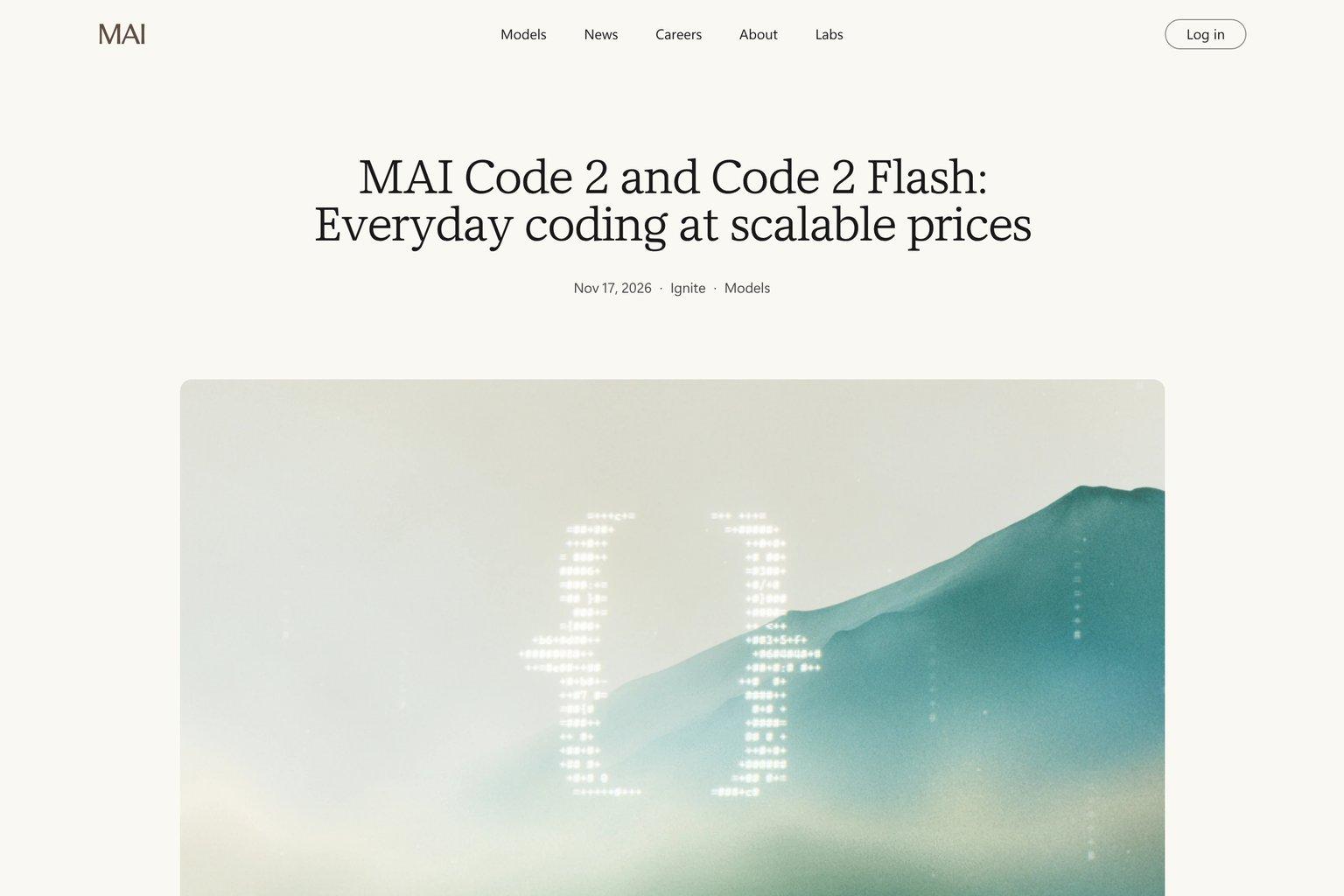
Cover image: screenshot of Microsoft AI's MAI Code 2 announcement (microsoft.ai).
Is MAI Code 2 really 40% of the cost of GPT-6.1 Sol?
Only at the 50% GitHub Copilot promo price, which ends on 17 May 2027. In Microsoft's own table, averaged over four benchmarks, MAI Code 2 costs $0.309 per task and GPT-6.1 Sol $0.761 (about 41%). By our calculation, at list price MAI Code 2 costs $0.618, about 81% of Sol's cost and about 18% less than Sol per solved task.
What will MAI Code 2 cost in GitHub Copilot after the promo ends in May 2027?
From 17 May 2027, GitHub lists MAI Code 2 at $1.00 input, $0.05 cached and $5.00 output per 1M tokens, and MAI Code 2 Flash at $0.10, $0.01 and $0.50. Both are double the promo rates, so the same usage costs twice as much from that day. Up to 272K tokens, MAI Code 2's list rate equals GPT-6.1 Terra's input and output rates.
How do I disable MAI Code 2 for my Copilot Business or Enterprise organization?
Turn off the MAI Code 2 model policy in your organization's or enterprise's Copilot settings, and MAI Code 2 Flash's too if you want both off. To stop future models switching on automatically, also turn off 'Default availability for released models'. Separately, enable 'Stop usage when budget limit is reached' on your enterprise or organization budget, because it is off by default.
Can I use MAI Code 2 outside GitHub Copilot, through an API or OpenRouter?
Not as of 18 November 2026. Microsoft's model card and announcement list MAI Code 2 only in GitHub Copilot. MAI Code 2 Flash is also in a limited-access Microsoft Foundry preview, with no price in Microsoft's launch materials. Neither model was on OpenRouter or Vercel AI Gateway, Microsoft says Flash is coming there 'soon' without a date, and the weights are not distributed.
Is MAI Code 2 Flash cheaper than GPT-6 Luna or Claude Haiku 5.5?
Against Claude Haiku 5.5, yes: at list price Flash costs about a third of Haiku per task on Microsoft's benchmarks, and a fifth per request above 100K tokens. Against GPT-6 Luna, only until the Copilot promo ends on 17 May 2027. At list, Flash costs 123-164% of Luna per task by our recalculation, despite the same per-token rate.
Can MAI Code 2 replace Claude Sonnet 5.5 or GPT-6.2 Sol for agentic coding?
Not for long autonomous agent runs. Microsoft says the models are 'not yet tuned' for very long-horizon agentic work. Its model card reports 26.3% on Terminal-Bench 4, against the 84.6% it headlines on the older Terminal-Bench 2.1. Early hands-on reports are positive on scoped one-shot fixes, but one heavy user, by their own account, rated it below Sonnet 5.5.