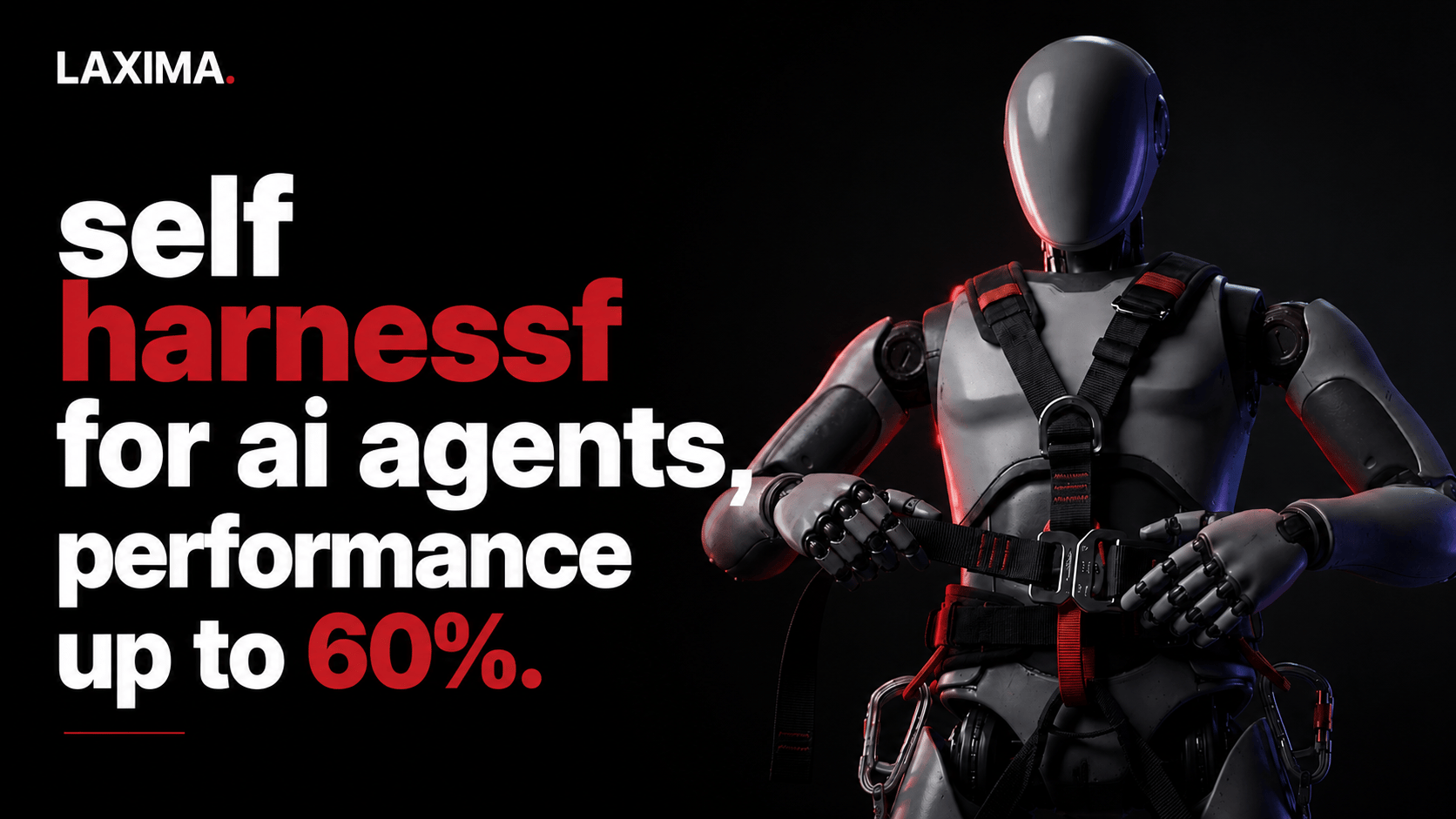
Self-Harness is a way for AI agents to improve the rules around their own behavior by analyzing failures, proposing small harness edits, and keeping only the changes that pass regression tests. It works best where outcomes are verifiable, experimentation is safe, and failure patterns are clear.
Key takeaways
In the Self-Harness paper covered by VentureBeat, held-out task performance improved by 33% to 60% relative across the evaluated models, with the base model, tools, and environment held constant while only the harness changed.
An agent harness is the layer around the model that includes prompts, tools, runtime policies, memory behavior, verification rules, and recovery logic.
Self-Harness depends on verifiable evaluation because the evaluator decides whether a proposed harness edit helps or creates regressions.
Automated harness improvement shifts work from prompt tweaking toward evaluation design, trace analysis, and governance.
Self-Harness is a strong fit for coding agents, internal workflow automation, and DevOps-style pipelines, and a poor fit for subjective or safety-critical decisions.
What is Self-Harness for AI agents?
Self-Harness is a framework in which an AI agent improves the rules around its own operation instead of relying only on a human engineer to rewrite prompts and policies.
The key term is harness. A harness is the control layer around a model: system prompts, tool definitions, runtime policies, retry rules, memory behavior, verification steps, orchestration logic, and failure recovery. If the model is the engine, the harness is the transmission, brakes, dashboard, and lane assist.
That distinction matters because many agent failures are not pure model failures. They are operating failures. The model may be capable of solving the task, but the surrounding rules let it loop, skip checks, misuse tools, overwrite files, or declare success too early. VentureBeat’s coverage of the research frames this as a harness-engineering problem rather than just a model-quality problem, which is the right lens for most enterprise deployments.
That is why enterprises should care. If you already use coding agents, internal copilots, or task-running assistants, the biggest gains often come from improving the operating loop around the model. We see the same pattern in client automation work: the first production bottleneck is rarely that the model lacks raw capability. More often it is weak verification, sloppy retries, poor context boundaries, or missing stop conditions.
Why does harness engineering matter more than most teams think?
Harness engineering matters because the same model can act like a useful operator or an expensive liability depending on the control logic wrapped around it.
Teams often treat prompt writing as the whole job. It is not. The harness decides whether the agent checks outputs before reporting success, whether it preserves environment state between actions, how it reacts to tool errors, and when it should stop. Those rules shape reliability far more than one clever instruction block.
VentureBeat lists examples of harness components and common failure modes: repeated failed retries, skipped verification, and context overload as interaction history grows. That matches a broader agent-systems pattern. As agents get more tools and more steps, orchestration quality becomes the constraint. If you want a practical view of how this shows up in real frameworks, LAXIMA has covered both agent framework tradeoffs in Vercel Eve and dynamic harness patterns in Claude Code.
One point is often missed: better models do not remove the need for harness engineering. They can increase it. A stronger model takes longer action chains, uses more tools, and explores more aggressively. That creates more surface area for operational mistakes. Smarter agents need tighter rails, not fewer.
How does Self-Harness actually work?
Self-Harness runs an iterative loop: mine weaknesses from failed traces, propose targeted harness edits, and validate those edits with regression tests.
The process has three stages:
Weakness mining: The agent runs tasks and produces execution traces with verifiable outcomes. Failed traces are grouped into recognizable failure patterns.
Harness proposal: A proposer role generates minimal harness edits tied to a specific failure mechanism.
Proposal validation: Candidate edits are tested. An edit is accepted only if it improves performance without unacceptable regression on held-out tasks.
This is more disciplined than ordinary prompt iteration. Instead of saying, “the agent felt weak, so we changed the system prompt,” Self-Harness creates a closed loop between behavior, diagnosis, change, and acceptance.
The loop resembles good software delivery practice: observe, isolate, patch, regress, promote. The novelty is that the agent helps rewrite the policy layer that governs its own actions.
A simple mental model: model, harness, evaluator
The cleanest way to think about agent improvement is as three separate layers:
Model: The reasoning engine generating actions and text.
Harness: The rules and environment shaping what the model can do and how it must behave.
Evaluator: The mechanism that scores outputs and rejects harmful changes.
Most teams over-focus on the first layer. Self-Harness is interesting because it upgrades the second layer using evidence from the third. If the evaluator is weak, the whole method falls apart.
What results did Self-Harness report?
Self-Harness reported meaningful relative gains on held-out tasks when only the harness changed.
VentureBeat states that the researchers evaluated the approach on Terminal-Bench-2.0 using MiniMax M2.5, Qwen3.5-35B-A3B, and GLM-5, starting from a minimal harness based on the DeepAgent SDK. With the model backend, tool set, benchmark environment, and evaluator kept unchanged, held-out task performance improved by 33% to 60% relative depending on the model.
Those numbers matter for one reason: they isolate harness value. The gains did not come from swapping in a better model or adding a bigger tool stack. They came from improving the operating rules.
That is why this topic matters commercially. For many companies, changing the harness is cheaper and faster than changing the whole stack. If your agent already has enough raw capability, the highest-return work is often in orchestration, evaluation, and memory discipline rather than model replacement. On that last point, persistent state and context management are frequent failure sources, which is why agent memory architecture deserves equal attention.
What kinds of agent failures can Self-Harness fix?
Self-Harness is best at fixing repeated, observable failure patterns such as loops, bad retries, missing verification, state loss, and premature task completion.
VentureBeat’s examples from the research are useful because they show concrete harness edits rather than generic improvement claims:
MiniMax M2.5: The agent got stuck exploring dataset configurations until timeout. Self-Harness added a loop breaker after 50 tool calls and a rule to create initial artifacts early.
Qwen-3.5: The agent repeated commands after file overwrite errors and deleted needed files. Self-Harness added strict duplicate-command limits and recovery rules for missing artifacts.
GLM-5: The agent failed to preserve environment changes across commands, wasted time on massive downloads, and finalized tasks despite failed sanity checks. Self-Harness added PATH persistence, compute limits, and repair-before-finish rules.
These examples point to a broader taxonomy of harness failures:
Failure class | Typical symptom | Harness fix |
|---|---|---|
Looping | Agent repeats similar actions until timeout | Tool-call caps, state-based stop rules, forced strategy shift |
Retry abuse | Agent reruns the same failing command | Duplicate-command guardrails, error-specific retry policies |
Verification gaps | Agent claims success without checking artifacts | Mandatory validation steps before completion |
State loss | Environment changes vanish across steps | Persistent session rules, state checkpoints |
Context overload | Agent forgets constraints or loses the thread | Summarization, memory compaction, scoped retrieval |
Unsafe exploration | Agent downloads too much or changes too much | Budget limits, permission boundaries, approvals |
This is where Self-Harness has practical value. It turns recurring mistakes into policy candidates. It does not magically solve intelligence. It improves operations.
When should you use Self-Harness instead of manual prompt tuning?
Use Self-Harness when failures are frequent, patterns are repeatable, and success can be scored automatically. Stick with manual tuning when tasks are sparse, subjective, or high-risk.
This is the decision framework we would apply in practice. Many teams jump too quickly from “manual tuning is tedious” to “the agent should rewrite itself.” That is the wrong shortcut. The better question is whether your environment can support empirical harness evolution.
The LAXIMA readiness test
Before adopting a self-improving harness loop, check five conditions:
Verifiable outcomes: Can you tell success from failure reliably?
Repeatable tasks: Do you have enough similar runs to reveal stable failure patterns?
Low-cost experimentation: Can the agent fail safely during evaluation?
Trace visibility: Do you log tool calls, outputs, and state transitions?
Regression discipline: Do you have held-out tasks that protect against local overfitting?
If you cannot answer yes to at least four of those five, manual harness engineering will probably outperform automated self-editing for now.
That is the missing decision criterion in most discussions of agent autonomy. The question is not whether the agent can improve itself. The question is whether your operating environment can tell a good self-change from a bad one.
Where does Self-Harness fit best in the enterprise?
Self-Harness fits best in internal systems where outputs are testable, guardrails are enforceable, and bad runs are reversible.
VentureBeat quotes the paper’s lead author identifying coding, internal workflow automation, and DevOps data pipelines as strong deployment targets, while warning against subjective or high-stakes domains such as medical, safety-critical, and legal decision-making.
That boundary is sensible. Here is a practical fit matrix:
Use case | Fit | Why |
|---|---|---|
Code generation and repo maintenance | High | Tests, linters, and CI provide deterministic evaluation |
DevOps runbooks | High | Operational checks and rollback paths are explicit |
Internal back-office workflows | Medium to high | Good fit if steps and outputs are structured |
Customer support drafting | Medium | Some metrics exist, but answer quality can be subjective |
Medical triage | Low | Errors are costly and evaluation is not safely iterative |
Legal recommendations | Low | Correctness is contextual and regressions are expensive |
If your team is still deciding whether it even needs agentic workflows, start with a broader architecture lens. LAXIMA’s guide to implementing agentic AI systems for business automation covers that foundation.
What are the hidden costs of Self-Harness?
Self-Harness reduces manual debugging effort, but it increases evaluation workload, compute usage, and governance demands.
VentureBeat highlights the trade-off clearly: automated proposal generation, parallel candidate evaluation, and regression testing mean more API tokens, more latency during optimization, and more infrastructure to run the evaluation loop.
That is only part of the cost. In practice, teams should expect four operational burdens:
Evaluation engineering: Building deterministic checks is harder than writing a prompt.
Trace storage and observability: You need logs good enough to classify failures.
Rollback and versioning: Harnesses become living artifacts that need release discipline.
Governance overhead: Someone must define where the agent is allowed to self-edit and where it is not.
The real lesson is simple: self-improving agents do not remove engineering work. They move it. The work shifts from one-off prompt changes to system design, evaluation design, and control-plane design.
That pattern mirrors broader enterprise AI reality. Reliability costs more than generation. LAXIMA has made that case directly in our guide to production-ready AI systems.
How do you keep Self-Harness from making your agent worse?
You prevent bad self-edits with narrow edit scopes, strict regression gates, and policy boundaries the agent cannot rewrite.
This is the biggest practical risk. A self-editing loop can optimize for the benchmark in front of it while damaging general performance, safety, or operational clarity. The paper’s acceptance rule helps by requiring improvement without measurable degradation on held-out tasks, as summarized by VentureBeat. That is necessary, not sufficient.
We recommend a three-zone governance model:
Green zone: The agent may edit local prompt wording, retry logic, ordering of checks, or summarization rules.
Yellow zone: The agent may propose changes to tool usage policy or memory behavior, but a human must approve promotion.
Red zone: The agent may not edit permissions, data access scope, legal constraints, spend limits, or human-approval requirements.
This zone model is one of the key additions missing from the source article. Self-improvement should apply to the operating harness, not to business governance itself.
Does Self-Harness replace human engineers?
No. It changes the engineering job from manual patching to feedback architecture, evaluation design, and policy supervision.
VentureBeat quotes the paper’s lead author saying the role shifts from prompt tweaking toward designing the feedback systems that make agent improvement possible. That framing is right.
The near-term winners will not be teams with the fanciest prompts. They will be teams with the best evaluators, the cleanest traces, the strongest rollback discipline, and the clearest boundaries between what an agent may optimize and what it must never change.
That also changes hiring and operating models. You need people who can combine product judgment, systems thinking, and software reliability practice. In AI-assisted delivery, architecture is gaining leverage over raw implementation speed, a shift we discuss in our analysis of how AI is reshaping the SDLC.
What should teams do next?
Start with one narrow, testable workflow and treat self-improving harnesses as an evaluation problem first, not an autonomy project.
A sensible rollout looks like this:
Pick a repetitive agent workflow with clear pass/fail outcomes.
Instrument full execution traces.
Write deterministic evaluators and a held-out regression set.
Limit self-edits to a green-zone subset of the harness.
Promote changes through versioned releases, not live mutation.
Review accepted edits for pattern value, then codify the good ones permanently.
That last step matters. Self-Harness should not become a black box that endlessly mutates itself. The point is to discover robust operating rules faster, then turn those discoveries into maintainable system behavior.
For teams building agents seriously, Self-Harness is not a curiosity. It signals that the center of gravity is moving from prompt craft to feedback systems. LAXIMA helps companies with this kind of work.
Original report: here
Frequently asked questions
What is the difference between an AI model and an agent harness?
An AI model generates text or actions, while the harness is the control layer around that model. The harness includes prompts, tool access, retry rules, memory behavior, verification steps, orchestration logic, and stopping conditions. Many real agent failures come from weak harness design rather than lack of model capability.
Why are regression tests so important for self-improving agents?
Regression tests stop the agent from making a local improvement that damages performance elsewhere. In Self-Harness, proposed edits are accepted only if they improve results without unacceptable degradation on held-out tasks. Without that safeguard, an agent can overfit to recent failures and become less reliable overall.
Can Self-Harness work for customer-facing AI agents?
It can, but only when success criteria are measurable and failure costs are controlled. Internal coding and operations workflows are a better fit because evaluation is more deterministic. Customer-facing tasks often include subjective quality judgments, brand considerations, and edge cases that are harder to score automatically.
Is Self-Harness the same as prompt optimization?
No. Prompt optimization changes instructions, while Self-Harness is broader. It can adjust runtime policies, verification rules, retry behavior, memory handling, and other orchestration logic around the model. The distinguishing feature is not just changing the prompt, but using execution traces and regression tests to decide which changes to keep.
What is the biggest risk in letting an agent rewrite its own harness?
The biggest risk is promoting harmful changes because the evaluation system is weak. If success is measured poorly, the agent can learn shortcuts, hide failures, or optimize for narrow benchmark conditions. Strong evaluators, held-out tasks, edit boundaries, and human approval for sensitive changes are the main defenses.